
We’re pleased to announce that NEXTBLUE, Asia’s first fund dedicated to women’s wellbeing and female founders, has participated in the Pre-Series A funding round of YStory, Inc., a Tokyo-based digital health company pioneering menopause care in Japan. The round was led by Kyoto University Innovation Capital, with co-investors including ASKA Pharmaceutical CVC, Kyoto Capital Partners, Seiho Investment Works, and existing investor ANRI.
Why Menopause Remains an Overlooked Crisis in Japan
Menopause affects every woman — yet in Japan, it has long been treated as a personal struggle rather than a public health priority. The data tells a striking story of a large, underserved population and a mounting economic problem that has only recently begun to receive serious policy attention.
The scale of the problem
Japan’s menopausal women represent a massive and growing workforce segment. Women aged 45–59 — the core perimenopausal and menopausal demographic — now account for over 33% of all working women in Japan, a share that has been rising steadily year over year.
Critically, this age group coincides precisely with the years when women begin to take on managerial responsibilities. Untreated menopause symptoms are therefore not just a health issue — they are a direct threat to women’s career trajectories at exactly the moment they matter most.
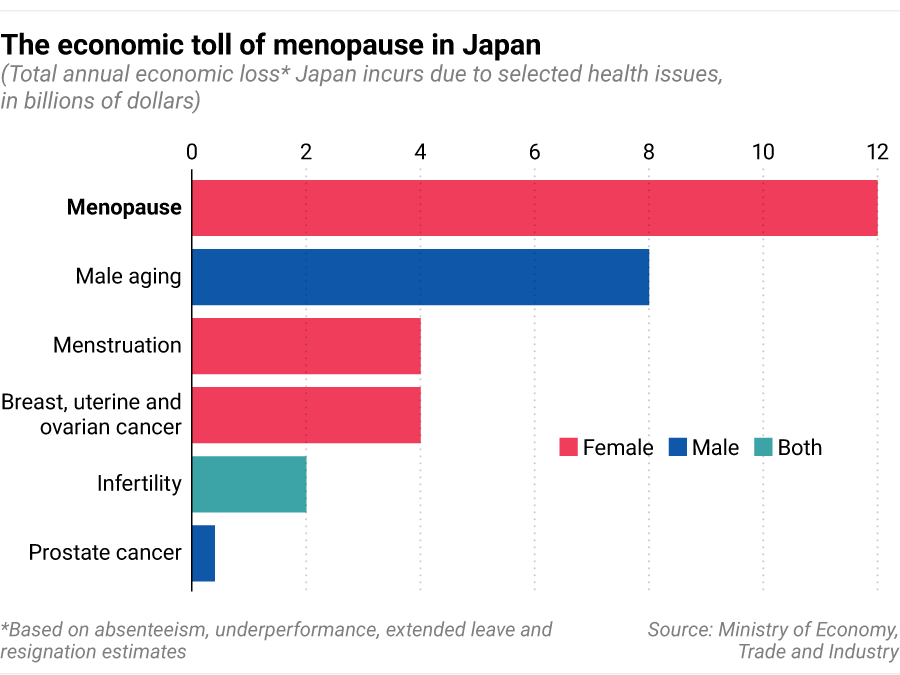
The economic toll is staggering. According to a 2024 estimate by Japan’s Ministry of Economy, Trade and Industry, menopause costs the Japanese economy approximately 1.9 trillion yen ($12 billion) annually in lost productivity, absenteeism, and job cessation — the single largest economic loss among all female-specific health conditions studied, exceeding menstruation, breast and gynecological cancers, and infertility combined. A national survey of over 26,000 respondents in 2021 found that 9.4% of women had quit their jobs due to menopausal symptoms.
The care gap
Despite the scale of the problem, the vast majority of affected women receive no formal care. According to Japan’s Ministry of Health, Labour and Welfare’s 2022 national survey, more than 80% of women in their 40s, and nearly 79% of women in their 50s experiencing menopausal symptoms had not visited a medical institution — with the most common reason cited being “I don’t think it’s serious enough to go to a doctor.” A further 18% said simply “I can bear with it.” Among those experiencing symptoms, roughly 42% across both age groups had taken no measures whatsoever to address them.
The Policy Tailwind
Japan’s regulatory environment is creating direct pressure on employers to advance women. From fiscal year 2023, companies with 101 or more employees are legally required to disclose female manager ratios, gender pay gaps, and male childcare leave uptake in annual securities reports. The Tokyo Stock Exchange has set a target of 30% female executives at Prime Market-listed companies by 2030.
Despite this pressure, progress remains slow. A July 2025 survey of 26,196 companies by Teikoku Databank found that the proportion of female managers crept up just 0.2 percentage points year on year to 11.1%, with companies where all managers are male still the largest group at 42.3% of the total. The gap between policy ambition and corporate reality remains stark.
This gap is increasingly understood as a health issue as much as a structural one. The government’s 2024 White Paper on Gender Equality found that among working women aged 40–69, “support for menopause” ranked among the top workplace accommodations women said would make it easier to work.
The logic is straightforward: if Japanese companies are under pressure to retain and promote women through their 40s and 50s, and menopausal symptoms are driving productivity loss and early exit at scale, then menopause care is no longer a personal health matter — it is a workforce strategy imperative.
Where Clinical Research Meets the Workplace — YStory’s Evidence-Based Menopause Platform
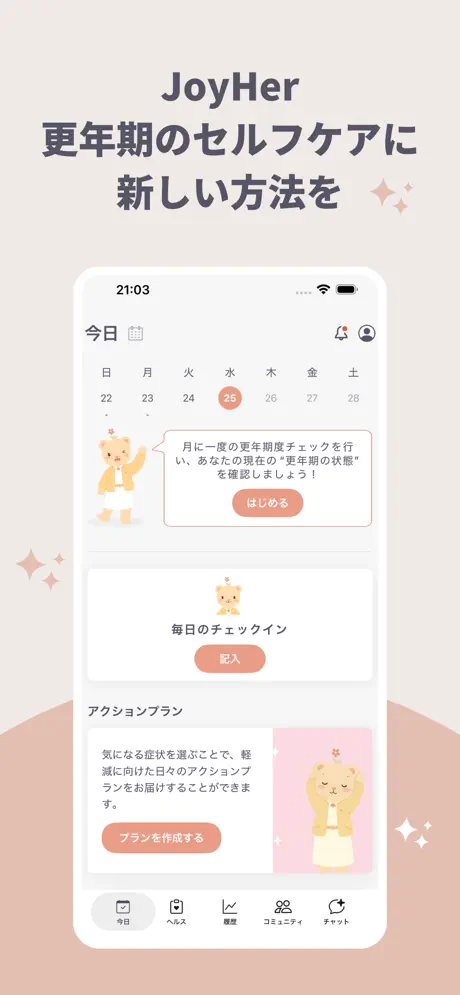
YStory operates Japan’s leading menopause app, JoyHer, with over 70,000 downloads to date — making it the country’s largest digital health platform focused on menopausal women. The app provides personalized self-care support, symptom tracking, and evidence-based guidance for women navigating perimenopause and menopause.
What sets YStory apart from most women’s health players is its commitment to clinical validation. In partnership with Professor Miho Egawa of Kyoto University’s Department of Obstetrics and Gynecology, YStory has been rigorously testing the efficacy of its digital interventions. A 2023 single-arm pre-post study of 91 menopausal women demonstrated statistically significant improvement in SMI (Simplified Menopausal Index) scores during the app usage period. A randomized controlled trial (RCT) involving approximately 400 participants is currently underway — an unusually rigorous standard for a digital health company at this stage.

Building on this clinical foundation, YStory has launched JoyHer for Enterprise, a B2B service for corporations and health insurance associations. The platform enables organizations to measure menopause-related health outcomes among employees, support self-care, and drive organizational culture change — all within an anonymized, psychologically safe design. Approximately 80% of users show improvement in SMI scores within 1–3 months of use.

YStory was founded in 2023 by Sherry Shi and Janet Yu, both of whom bring a data science and technology background to a domain that has historically lacked both.
Why We Invested
NEXTBLUE invests at the intersection of women’s health, wellbeing, and female-led innovation across Japan, the US, and Europe.
The global menopause care market is accelerating rapidly — in Europe and North America, it has become a recognized convergence point of healthcare, employee benefits, and digital health. Japan is at an earlier stage, but the conditions for meaningful change are increasingly in place: rising awareness among employers, growing media coverage, and national policy pressure to retain women in the workforce.
YStory is one of the very few companies positioned to lead this shift in Japan. Its combination of a large, proprietary user dataset, a clinical evidence roadmap, and a scalable B2B product gives it a defensible foundation that pure consumer apps cannot replicate. We believe menopause should not end at the individual — it should be recognized as a societal infrastructure issue, and YStory is building exactly that.